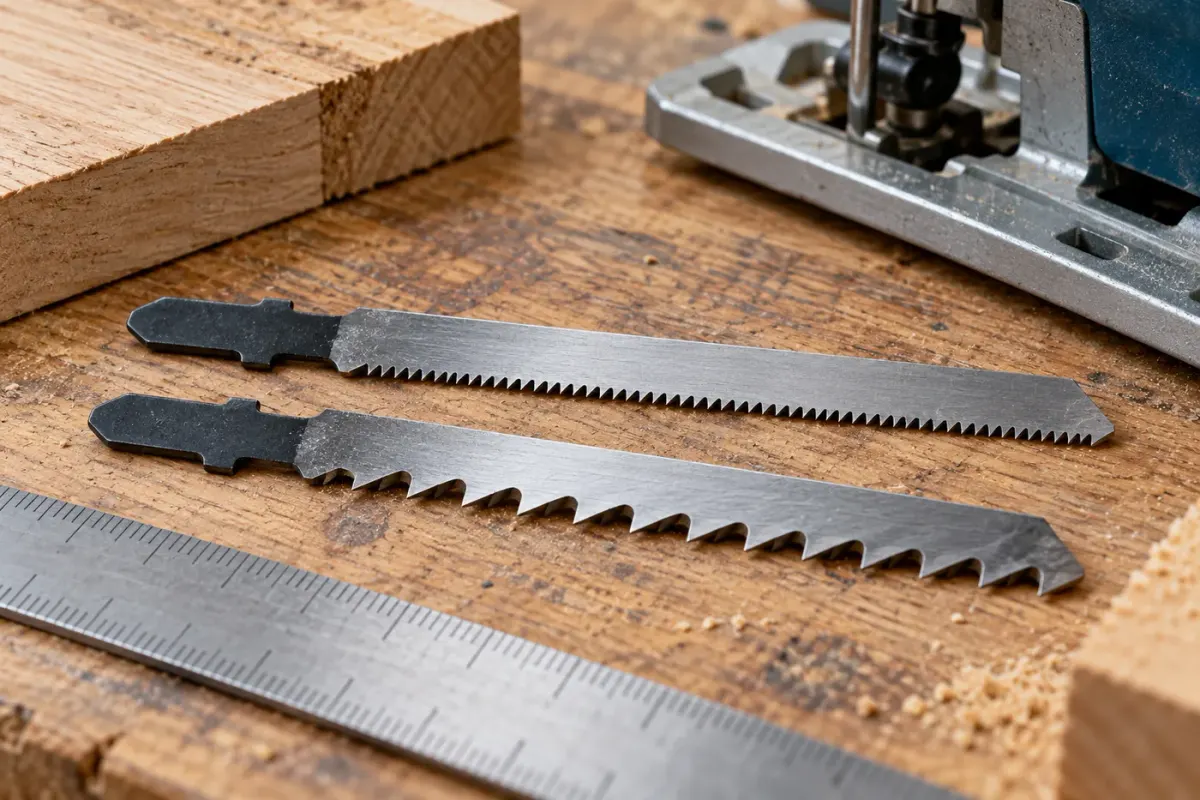
Understanding Jigsaw Blade TPI: Choosing the Right Tooth Pitch
Demystify TPI. Learn how tooth spacing dictates whether your saw produces a fast rough cut or a satin-smooth finish.
Published by: Sierras de CalarLast reviewed on ◷ 1 min estimated read
TPI stands for Teeth Per Inch, and it is the single most important metric on any jigsaw blade package. Choosing the wrong TPI will result in chipped veneers, ruined blades, or burned motors.
TPI (Teeth Per Inch) measures the number of cutting tooth tips packed into one linear inch of blade length. In European catalogs, this is often expressed as tooth pitch in millimeters (e.g., 2.5 mm pitch ≈ 10 TPI; 4.0 mm pitch ≈ 6 TPI).
The Fundamental Rule of TPI: Speed vs. Smoothness
Low TPI (4 to 8 TPI): Large, aggressive teeth with massive chip gullets. Cuts through dimensional 2x4 lumber and structural timber at blistering speed, but leaves rough, splintered edges.
Medium TPI (9 to 12 TPI): The ideal workshop compromise. Delivers clean, splinter-free cuts in plywood, solid hardwoods, and laminated panels at moderate feed speeds.
High TPI (14 to 24 TPI): Fine, densely packed teeth designed for hard, thin materials like sheet metal, PVC, and copper pipe.
The “3-Teeth Rule” for Thin Materials
Whenever you cut metal, acrylic, or thin plywood, at least 3 teeth must be in continuous contact with the material thickness throughout the stroke.
If the material is thinner than the tooth spacing, the metal catches in the gullet, violently jamming the saw and stripping teeth off the blade.
For clean cuts in solid wood and plywood, 10 TPI (such as the Bosch T 101 B) is the universal workshop standard. For fast rough framing, use 6 TPI (Bosch T 144 D).
What TPI is required for cutting sheet metal?
Thin sheet metal requires 14 to 24 TPI. At least 3 teeth must engage the metal thickness simultaneously to prevent tooth stripping.