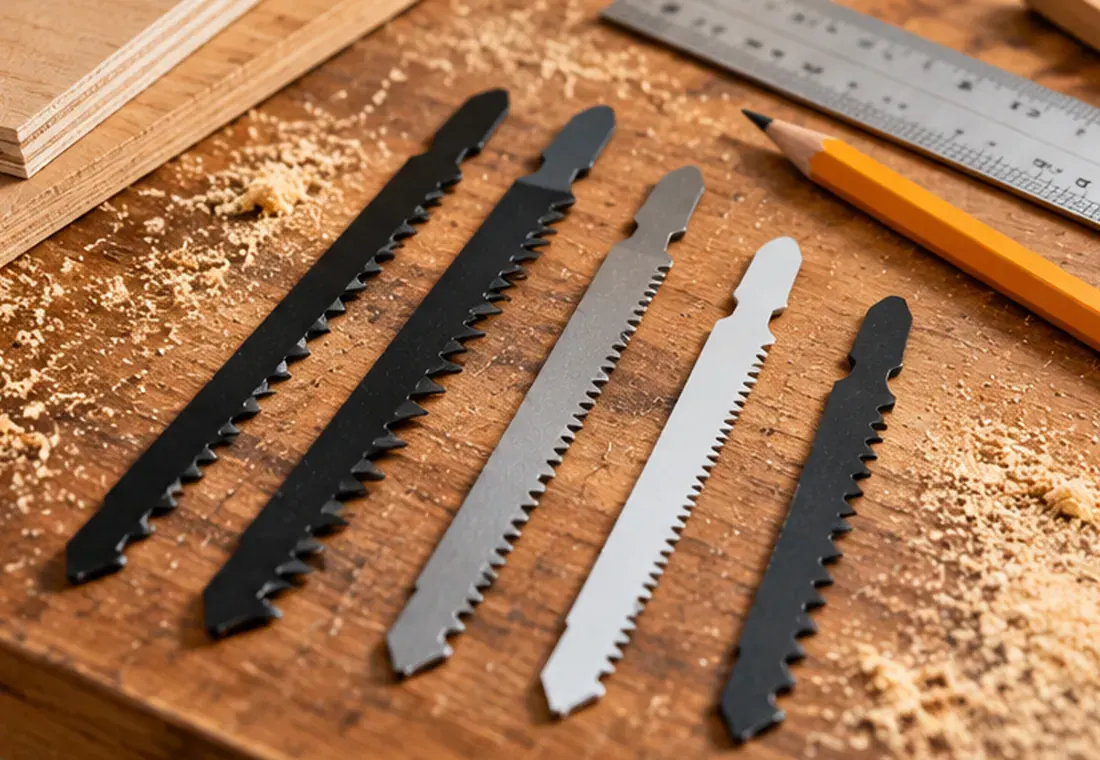
Types of Jigsaw Blades: The Complete Guide to T-Shank, TPI, and Materials
Decode shank types, tooth counts (TPI), metallurgy, and cut direction to choose the perfect blade for wood, metal, plastic, or ceramics.
Published by: Sierras de CalarLast reviewed on ◷ 2 min estimated read
Swapping your jigsaw blade affects cut quality far more than buying an expensive new saw. Mounting the wrong blade leads to burning wood, wandered bevels, and splintered laminate. Choosing the right blade transforms even a modest jigsaw into a surgical cutting tool.
Swapping your jigsaw blade affects cut quality far more than buying an expensive new saw. Mounting the wrong blade leads to burning wood, wandered bevels, and splintered laminate. Choosing the right blade transforms even a modest jigsaw into a surgical cutting tool.
Before purchasing replacement blades, decode these four key technical specifications:
1. Shank Type: T-Shank vs. U-Shank
T-Shank (Tang Shank): The dominant global standard. Features a cross-bar ‘T’ shape at the tang that allows tool-less, quick-eject lever insertion in all modern Bosch, DeWalt, Makita, Milwaukee, and Ryobi jigsaws.
U-Shank (Universal Shank): An older design featuring a crescent cutout on the tang. Requires a hex wrench or slotted screw collar. Most modern cordless saws do not support U-shank blades.
2. Understanding TPI (Teeth Per Inch)
Tooth count dictates the balance between speed and edge smoothness:
6 to 8 TPI (Coarse / Fast): Large teeth with deep gullets. Rapidly clears thick sawdust chips. Ideal for framing 2x4s, subflooring, and rough carpenter cutoffs where edge finish is not critical (e.g., Bosch T144D).
10 to 12 TPI (Medium / Clean): Precision ground teeth that cut without splintering. The gold standard for furniture joinery, finish trim, and plywood (e.g., Bosch T101B).
14 to 24 TPI (Fine / Metal & Sheet): Very small, closely spaced teeth. At least 3 teeth stay in continuous contact with thin stock to prevent snagging (e.g., Bosch T118A).
HCS (High Carbon Steel): Economical and flexible. Best for softwoods, pine, and OSB.
BIM (Bi-Metal): Combines an HSS tooth edge laser-welded to a flexible alloy body. Resists breakage and lasts 5x longer when cutting abrasive hardwoods, laminate, and embedded nails.
HM / Carbide: Tungsten carbide tips that cut abrasive cement board, fiberglass, ceramic tile, and cast iron.
4. Blade Body Width: Straight Cuts vs. Tight Scroll Curves
Standard Width (approx. 3/8”): The broad spine keeps the cut path rigid and straight, resisting sideways deflection.
Narrow Scroll Blades (approx. 5/32”): Blades like the Bosch T101AO feature a slender, narrow spine and a pointed plunge tip that allows the saw to pivot tightly along complex curves, circles, and gingerbread scrollwork without binding in the kerf.
Frequently Asked Questions
Are T-shank and U-shank jigsaw blades interchangeable?
No. T-shank blades (with single-lug tangs) have become the universal standard adopted by Bosch, DeWalt, Makita, Milwaukee, Ryobi, and Festool, enabling tool-free lever insertion. U-shank blades (with a rounded notch) require an Allen wrench or screw collar and will not fit modern tool-free T-shank clamps.
What does TPI mean on a jigsaw blade?
TPI stands for Teeth Per Inch. A low TPI (6 to 10 TPI) means large teeth with deep gullets that cut lumber quickly and clear big chips, but leave a rough surface. A high TPI (14 to 24 TPI) means tightly packed, fine teeth that cut slowly, produce minimal tear-out, and are essential for thin sheet metals, laminate, and plastics.
What is the difference between HCS, HSS, BIM, and Carbide blades?
HCS (High Carbon Steel) is flexible and ideal for softwoods. HSS (High Speed Steel) is harder and withstands friction in non-ferrous metals. BIM (Bi-Metal) welds an HSS tooth strip onto a flexible HCS backing, offering 5x the lifespan for hardwoods, nails, and steel sheet. Carbide-tipped blades feature tungsten-carbide teeth brazed onto steel to slice abrasive fiberglass, drywall, tile, and stainless steel.