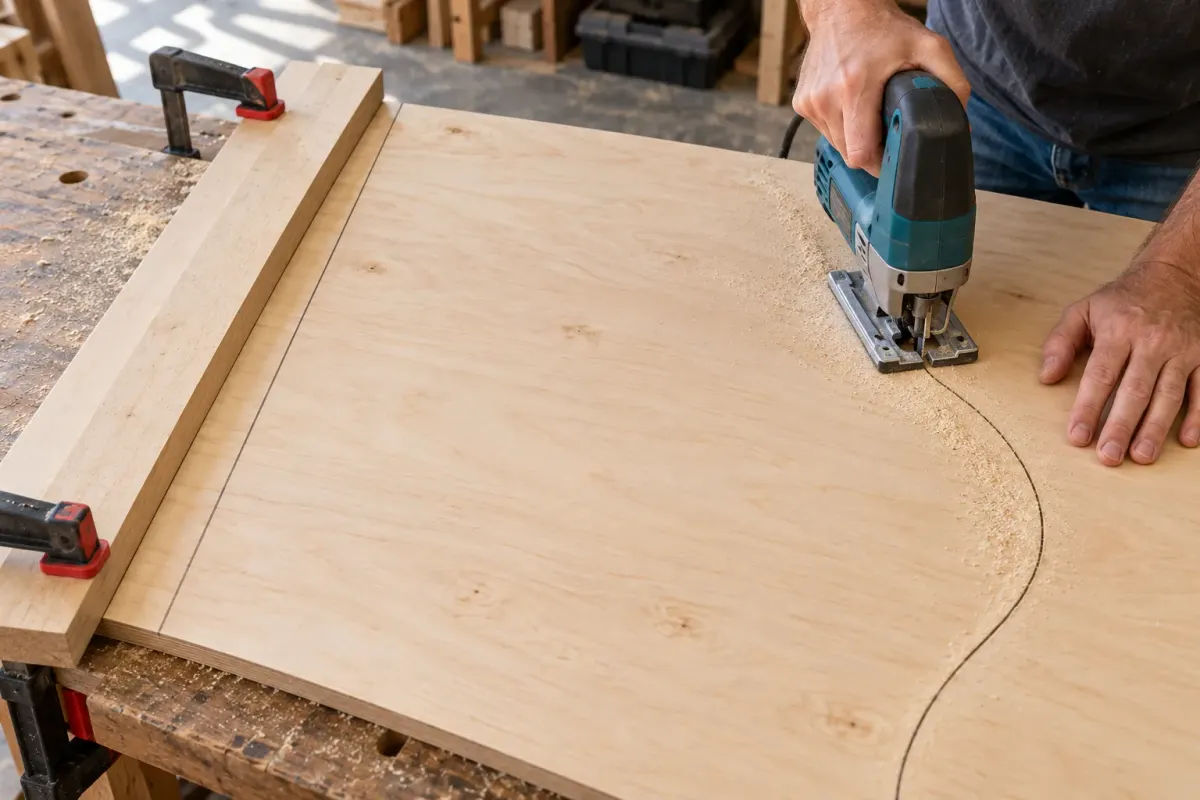
Mastering Straight and Curved Jigsaw Cuts: Essential Techniques
A jigsaw can cut dead-straight lines and intricate circles when set up with the correct blade width and feed pressure.
Published by: Sierras de CalarLast reviewed on ◷ 2 min estimated read
Many woodworkers believe jigsaws are only good for sloppy rough curves. With the right blade width, feed technique, and guide accessories, you can produce laser-straight lines and razor-sharp scrollwork.
The Fundamental Rule: Blade Width Governs Cut Geometry
The secret to mastering both straight and curved passes lies in understanding blade beam width:
Wide Blades (7–10 mm wide): High beam strength resists lateral flex. Ideal for straight passes along an edge guide (e.g., Bosch T 101 B, Bosch T 144 D).
Narrow Scroll Blades (4–5 mm wide): Slender body turns on a dime with zero bind. Indispensable for tight circles and scrollwork (e.g., Bosch T 119 BO, Bosch T 244 D).
Technique for Dead-Straight Cuts
Use a Rigid Clamped Straightedge: Clamp an aluminum level or track guide parallel to your cut line, accounting for the offset from the base plate edge to the blade center.
Set Orbital Action to 0 or 1: High orbital action induces micro-wandering.
Steady Forward Feed: Do not force the saw forward. Let the teeth slice through the timber; pushing too hard causes the blade to flex backward and bevel off 90 degrees.
Technique for Tight, Fluid Curves
Use Relief Cuts: Make straight entry cuts through the scrap material directly to your curve line every 2 to 3 inches. As you navigate the curve, the scrap falls away cleanly.
Steer from the Rear: Guide the tool gently from the rear of the handle or barrel grip. Never apply sideways pressure to the front blade clamp.
Why does my jigsaw blade bend and wander when cutting curves?
Wide-body straight blades cannot turn tight radii without twisting. You must switch to a narrow-body scroll blade (like the Bosch T 119 BO) and let the blade cut at its own pace without sideways forcing.
How do I cut tight circles without the blade binding?
Cut radial relief cuts into the waste area up to your layout line. As you turn the corner, the waste chunks drop away, releasing lateral pressure on the blade.