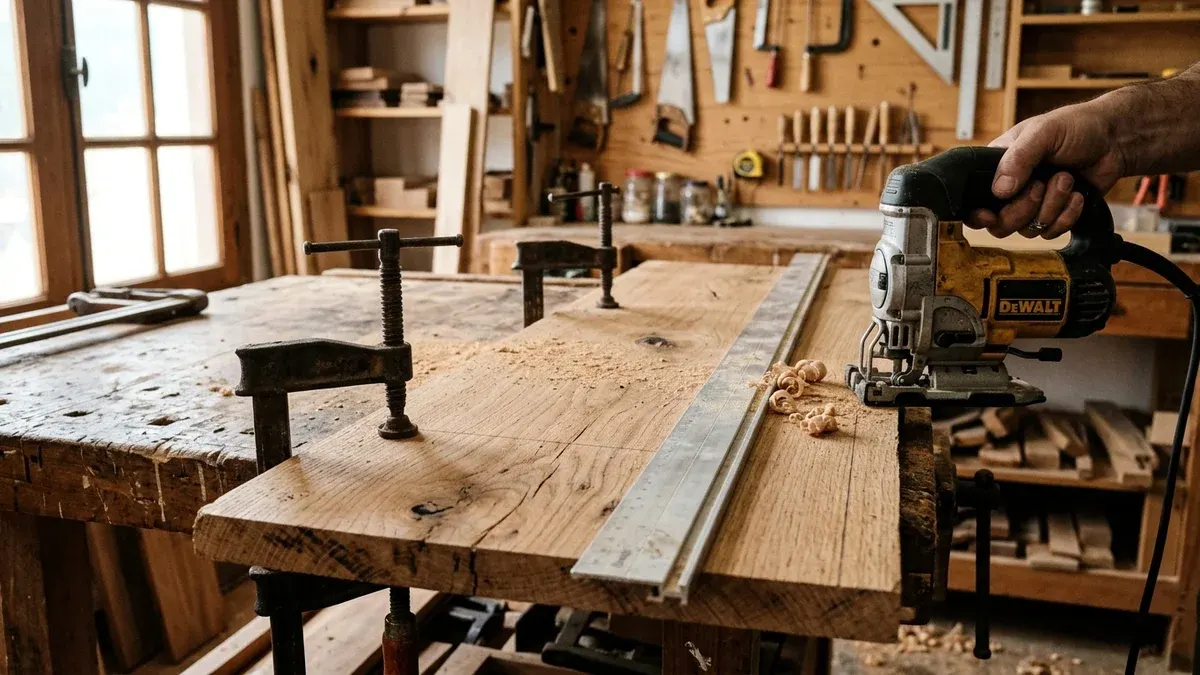
1. Calculating Your Shoe Offset Measurement
A jigsaw cannot cut directly against your clamped fence because the blade sits centered beneath the body:
- Unplug the tool or remove the battery.
- Measure the exact distance from the outer side of the blade teeth to the left (or right) outer edge of the metal base shoe.
- On most popular saws (such as the DEWALT DCS334B or Bosch JS470E), this offset is typically between 1-3/8 in. and 1-1/2 in.
- When marking your wood, measure your desired cut line, then mark your clamping line offset by that exact distance.
2. Choosing the Right Guide Fence
Never use a warped 2x4 as a fence. Any imperfection in the guide will telegraph directly into your cut:
- Best Option: An extruded aluminum box level (48 in. or 72 in.) or a dedicated aluminum clamping guide rail.
- Securing: Fasten both ends with quick-action bar clamps. Ensure the clamps do not sit in the path of the jigsaw motor housing.
3. Selecting a Stiff, Non-Deflecting Blade
Standard thin-gauge blades flex when they meet uneven wood grain:
- Avoid: Ultra-slender scroll blades (T 101 AO, T 244 D).
- Choose: Heavy-duty precision blades with increased thickness (0.05 in. / 1.3 mm kerf) such as the Bosch T 144 DP (Precision for Wood) or Festool S 75/4 FSG. Their rigid spine resists lateral twisting.
4. Proper Forward Feed Mechanics
- Orbital Setting: Set orbital action to Position 0 or 1. Excessive pendulum motion makes the saw buck and wander off the straight edge.
- Two-Handed Grip: Place one hand on the handle trigger and your secondary hand gently resting on the top of the motor head.
- Maintain Constant Contact: Keep the edge of the jigsaw shoe riding smoothly against the aluminum rail with light, steady inward pressure.
- Do Not Push Aggressively: Let the high stroke speed (3,000+ SPM) slice the fibers. Forcing the tool forward causes the blade tip to lag behind the motor, inducing vertical bevel deviation.
Discover high-stability saws in our US Jigsaws Review Hub and browse precision blades in our Jigsaw Blades Catalog.