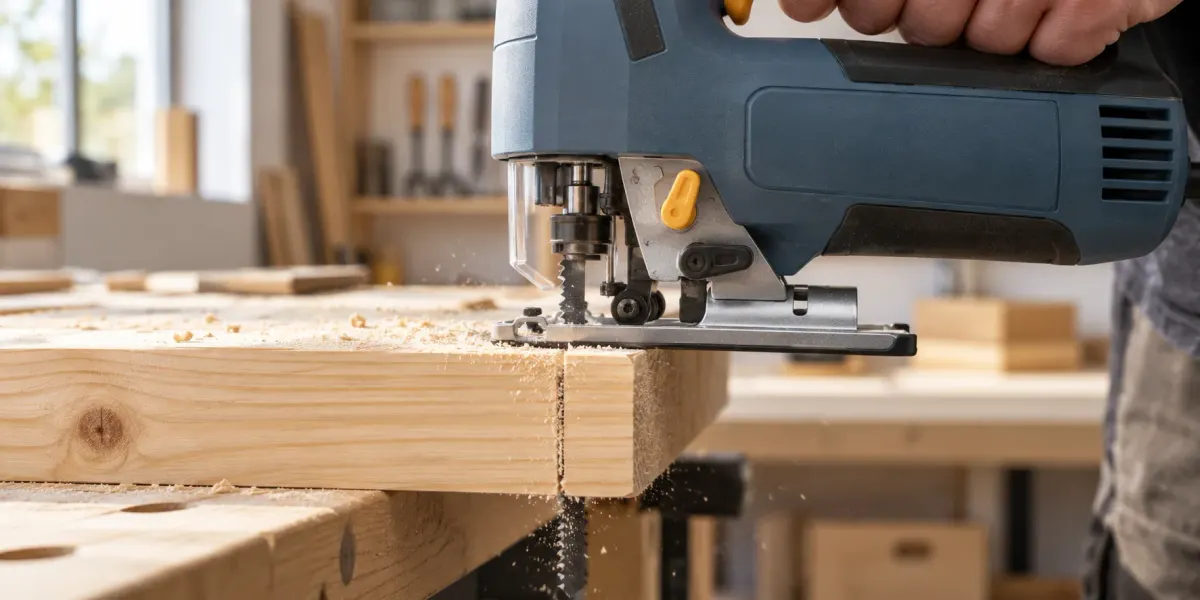
The Mechanics of Orbital Pendulum Action
On a non-orbital jigsaw, the blade moves strictly straight up and down in a vertical reciprocating line.
On an orbital saw, an internal eccentric cam swings the guide roller forward during the upward cutting stroke, thrusting the blade aggressively into the timber. On the downward stroke, the blade retreats backward, allowing sawdust to drop out freely.
Comprehensive Settings Guide (0 to 3)
Setting 0: Straight Reciprocation (Orbital OFF)
- Materials: Sheet metal, aluminum, copper pipes, PVC, acrylic, and double-sided melamine veneers.
- Why: Delivers the cleanest edge quality with zero tooth slamming. Mandatory for metals and brittle plastics.
Setting 1: Low Orbital Action
- Materials: Hardwoods (white oak, hard maple, walnut) and dense cabinet-grade plywood.
- Why: Adds modest cutting speed while preserving a smooth surface finish with minimal tear-out.
Setting 2: Medium Orbital Action
- Materials: Softwood framing studs (pine, fir, cedar) and general dimensioning.
- Why: The sweet-spot workhorse setting for remodeling and jobsite framing.
Setting 3: Maximum Aggressive Orbital Action
- Materials: Rough dimensional lumber (2x4, 2x6, 4x4), demolition work, and rapid framing cutouts.
- Why: Maximum material removal at blistering feed speed; leaves a rough, splintered edge.
Compare orbital features in our US Jigsaws Catalog and check our Blade Selection Guide.