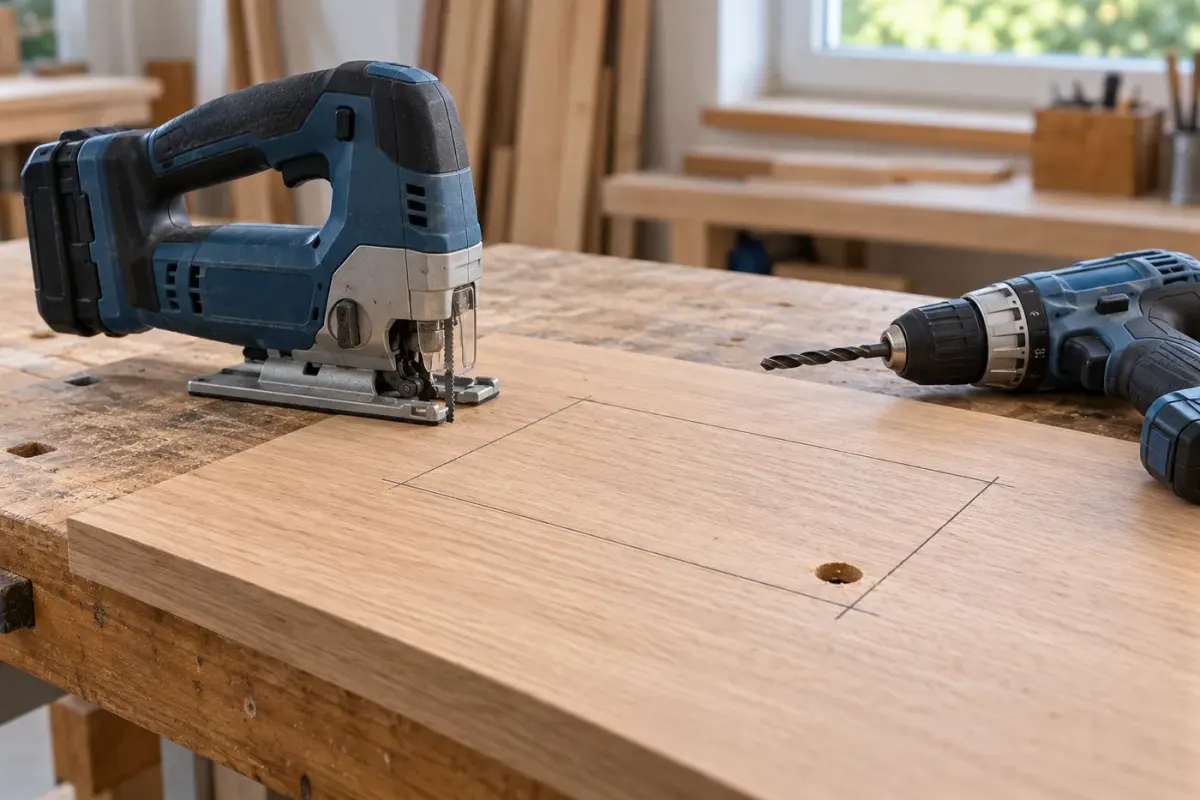
Method 1: The Starter Hole Technique (Recommended for Accuracy)
For kitchen countertops, fine cabinetry, and precise electrical junction boxes, drilling starter pilot holes is the gold standard:
- Mark Your Opening: Accurately trace the cutout perimeter with a fine pencil.
- Drill Corner Relief Holes: Chuck a 3/8 in. or 1/2 in. spade or brad-point bit into your cordless drill. Drill one hole in each of the four corners, keeping the bit tangent inside your layout lines.
- Drop the Jigsaw In: Insert the jigsaw blade into one starter hole, line up the shoe flat on the work, and cut cleanly to the next corner.
- Support the Center Slug: Clamp or screw temporary wood cleats across the cutout so the heavy center piece doesn’t drop prematurely and tear out the final corner.
Method 2: Freehand Plunge Cutting (For Rough Framing & Subflooring)
In subflooring and framing lumber where corner appearance does not matter, skilled operators can plunge cut directly without pre-drilling:
- Select a Plunge-Tip Blade: Use an aggressive wood blade with a sharp pointed tip (e.g., Bosch T 144 D).
- Position the Shoe: Tilt the jigsaw forward so the front lip of the base plate rests firmly flat on the lumber, with the blade suspended a half-inch above the surface.
- Start the Motor: Squeeze the trigger to reach full cutting speed (3,000+ SPM) before touching wood.
- Slowly Pivot Downward: Use the front lip of the shoe as a hinge, slowly lowering the blade into the timber until it breaks through, then flatten the shoe and complete your pass.
Read our Countertop Sink Guide and explore our US Jigsaws.