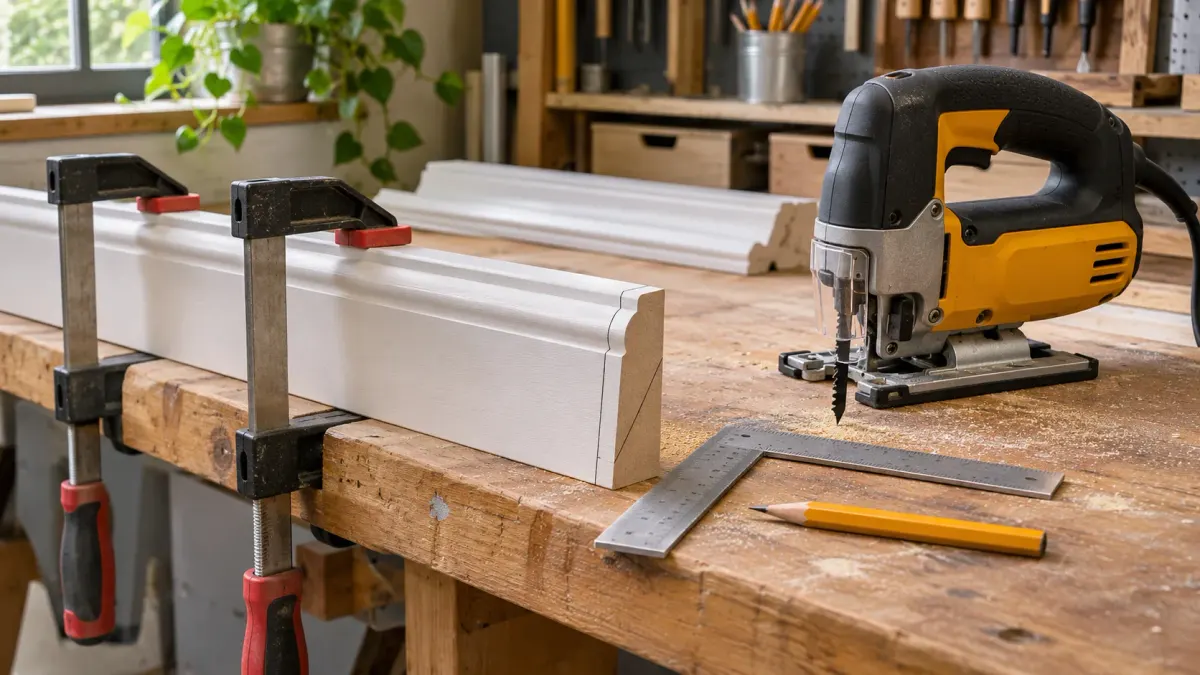
How to Cut Baseboards and Trim Molding with a Jigsaw
Master coping inside corners and scribing baseboard trim to fit perfectly against wavy plaster walls.
Published by: Sierras de CalarLast reviewed on ◷ 2 min estimated read
While miter saws handle outside corners, veteran trim carpenters rely on a jigsaw to cope inside baseboard corners and scribe trim tightly against uneven drywall.
Inside corners in residential homes are almost never a perfect 90 degrees. Coping involves cutting the profile of one baseboard piece so it fits snugly over the face of the adjoining piece:
Cut a 45-Degree Inside Miter: This reveals the exact profile line of the baseboard face.
Highlight the Profile: Run a pencil lead along the crisp mitered edge to create a high-contrast guide line.
Back-Bevel with Your Jigsaw: Tilt the jigsaw base shoe slightly or tilt the tool back (approx. 5 to 10 degrees back-bevel). This ensures only the front decorative edge touches the wall, preventing the back timber from holding the joint open.
Follow the Coped Line: Using a narrow scroll blade like the Bosch T 119 BO, carefully trace the profile curve.
Scribing Baseboards to Out-of-Level Floors
When installing tall baseboards over sloping hardwood or tile floors:
Lay the baseboard along the wall.
Set a compass or scribing tool to the maximum floor gap.
Run the compass along the floor, transferring the contour onto the baseboard face.
Follow the scribed line with a high-TPI jigsaw blade (like Bosch T 101 B) with orbital action set to 0.
Why cope baseboard corners instead of 45-degree miter cuts?
Inside 45-degree miters open up ugly gaps as framing timber expands and contracts seasonally. A coped joint overlaps tightly and remains completely invisible forever.
Which blade is recommended for coping trim molding?
Use a narrow-body scroll blade such as the Bosch T 119 BO or Bosch T 101 AO. The slender blade spine turns tight profiles without binding.