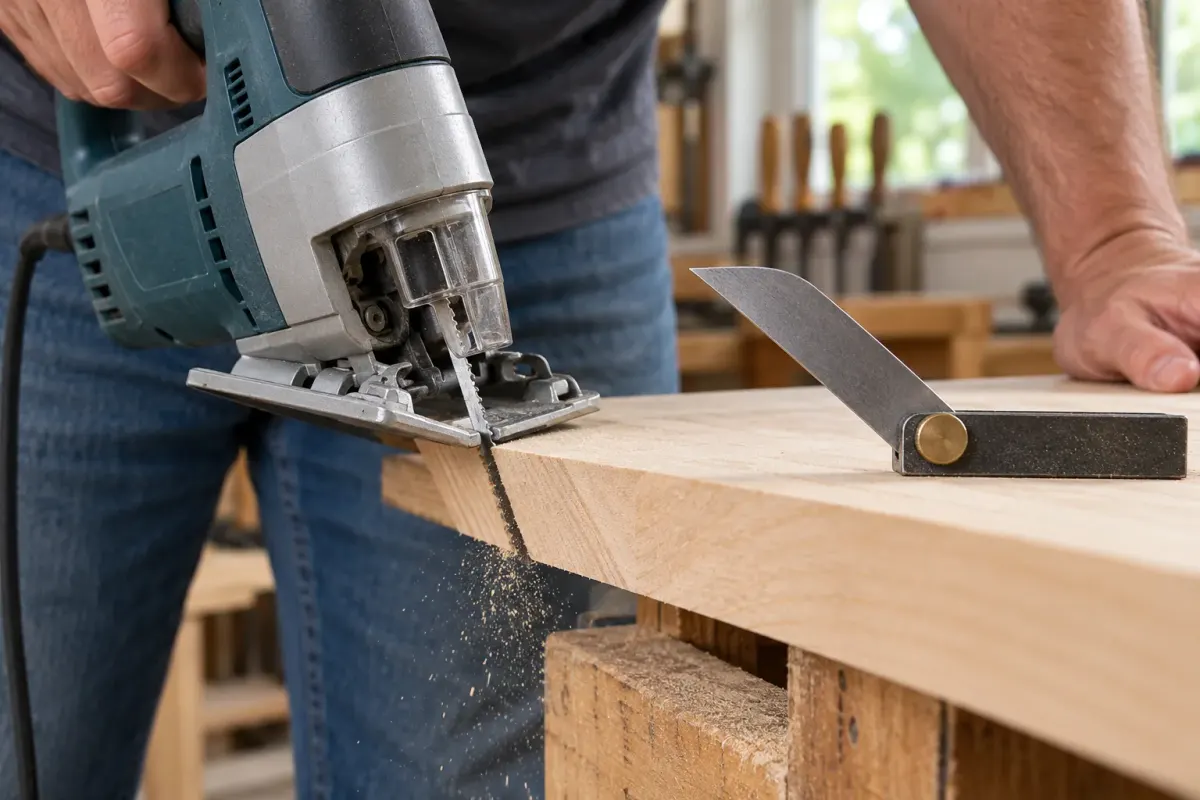
Cutting an accurate 45-degree bevel with a jigsaw requires more than simply snapping the baseplate to the stamped 45° mark. Consistent joint quality depends on precise angular calibration, workpiece clamping, and eliminating blade flex.
Whether you are crafting corner miters, chamfering tabletop edges, or fitting fascia boards, this proven workshop workflow guarantees tight, gap-free joints.
Step-by-Step Method for Precise 45-Degree Cuts
- Disconnect Power: Remove the battery or unplug the power cord before adjusting the footplate mechanism.
- Loosen the Baseplate Pivot: Release the tool-free bevel lever or loosen the hex bolt on the underside of the shoe plate. Tilt the base until it approaches the 45-degree detent.
- Calibrate with a Precision Square: Place a 45° combination square or digital angle finder flat against the underside of the shoe plate and against the flat body of the blade (avoid touching the offset tooth points). Adjust the tilt until light cannot pass through the gap, then lock the clamping mechanism down tightly.
- Choose an Extra-Thick Blade: Standard jigsaw blades are 0.04” thick and flex easily during angled cuts. Mount an extra-thick precision blade like the Bosch T144DP Precision for Wood (0.07” body thickness) to resist lateral bending forces.
- Turn Orbital Action to 0: Pendulum oscillation pushes the blade off-axis during bevel cuts. Turn the orbital selector switch strictly to 0.
- Clamp a Straightedge Guide: Never attempt freehand 45-degree cuts. Clamp a straight aluminum guide bar or rigid level offset from your cut line by the exact distance between the jigsaw shoe edge and the blade kerf.
- Maintain Steady, Gentle Forward Feed: Press the jigsaw shoe firmly against the straightedge and downward onto the board surface. Let the teeth cut smoothly without pushing aggressively from behind.
Workshop Tips for Tight Miter Joints
- Cut a Test Scrap First: Always test your setup on a cutoff piece from the same board. Place two 45° test cutoffs together against a 90° framing square to confirm the joint closes cleanly without daylight showing along the seam.
- Keep the Wide Shoe Side on the Supported Board: Jigsaw baseplates are asymmetrical when tilted. Ensure the wider side of the base rests firmly on the supported, clamped board rather than the falling offcut.