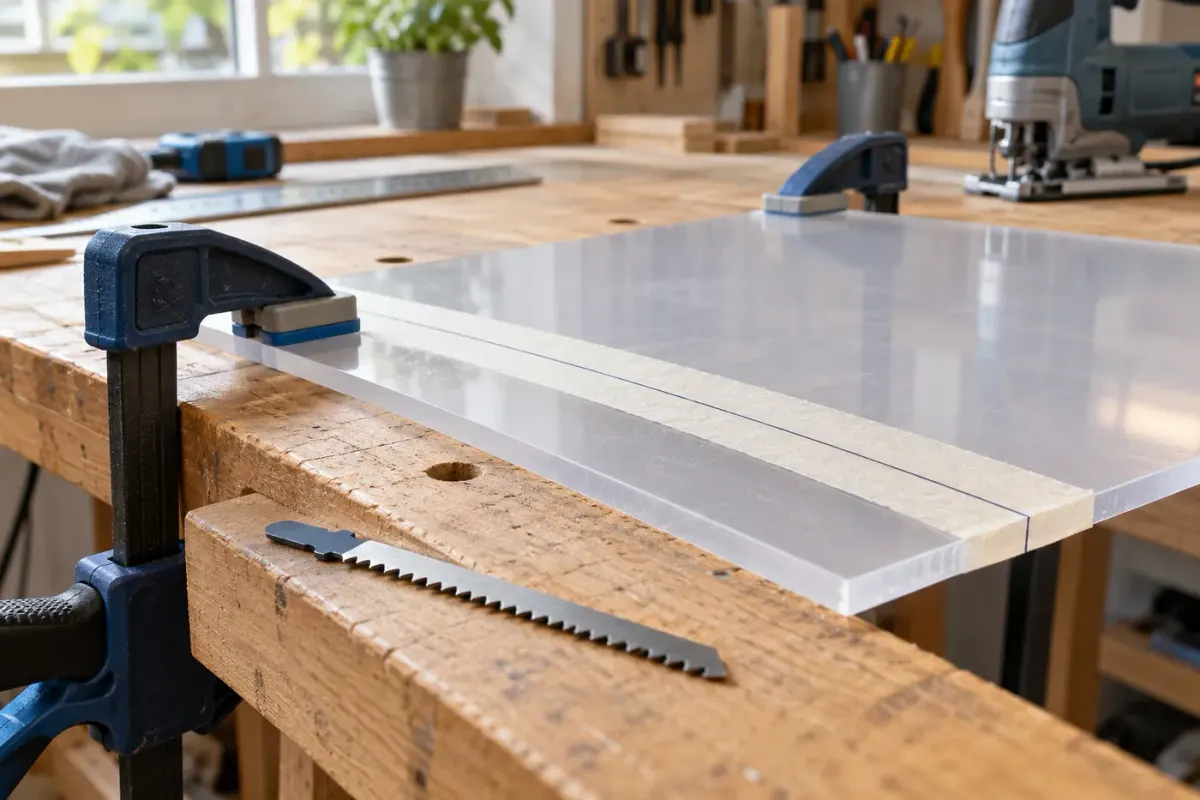
The Challenge: Friction and Melting Points
Plastics react very differently than timber:
- Thermoplastics (PVC, Acrylic, Polycarbonate, ABS): Soften and liquefy rapidly under frictional blade heat.
- Thermosets (Bakelite, Fiberglass composites): Highly abrasive; dull standard carbon steel blades quickly.
Step-by-Step Rules for Clean Plastic Cuts
1. Slow Down the Stroke Speed (SPM)
Set your jigsaw’s variable-speed dial to setting 2 or 3 (approx. 1,000 to 1,500 SPM). Slowing down dramatically reduces thermal build-up along the cut line.
2. Disengage Orbital Pendulum Action
Always set orbital action to 0. Orbital swing hammers into brittle acrylics, causing stress fractures and jagged edge blowout.
3. Leave Protective Film Intact
Keep the factory masking paper or blue plastic film on your acrylic or polycarbonate sheet. It protects against shoe scratches and prevents chipped edges.
4. Choose Ground, Side-Set Blades
Select dedicated plastic blades such as the Bosch T 102 H. These blades have tooth clearance angles that slice plastic cleanly without friction drag.
Read our full Plexiglass Cutting Guide and browse compatible Specialty Blades.