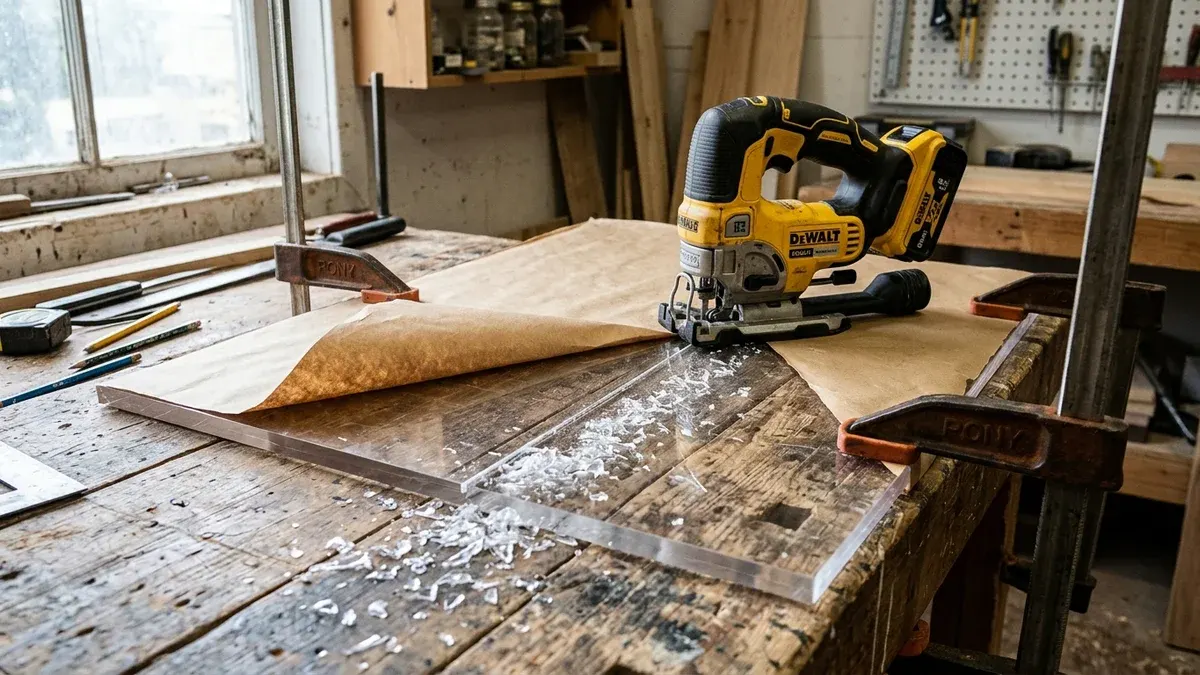
The most aggravating failure when cutting acrylic (Plexiglass) or polycarbonate with a jigsaw is watching the cut re-weld itself directly behind the blade. Reciprocating friction builds instant heat, turning solid thermoplastic into molten sludge that fuses the kerf shut and leaves an ugly, jagged scar.
Thermoplastics require a completely different approach than lumber. If you run the jigsaw too fast, plastic melts; if you push too hard or vibrate the sheet, it fractures like window glass. With three fundamental mechanical controls, you can cut optical-grade edges smoothly on the first try.
Why Thermoplastics Trap Heat in the Kerf
Unlike structural wood (which chars into sawdust) or mild steel (which rapidly conducts thermal energy across its surface), acrylic (PMMA) and polycarbonate (PC) are excellent thermal insulators. Almost 100% of the friction energy generated by reciprocating steel teeth remains trapped right inside the narrow kerf.
If you make the mistake of using a fine-toothed metal blade, the plastic shavings have zero room to escape. They pack tightly into the blade gullets, compress against the kerf walls, liquefy into hot sludge, and solidify behind the saw.
The Right Blade: Deep Gullets and Conical Relief Grinding
Standard blades with wavy sets rub continuously against plastic cut walls. You need a blade designed specifically for synthetic polymers:
- Top Choice: Bosch T102H (Clean for PVC / Plastics): Features conical ground tooth relief and 11 TPI spacing. The wide tooth gullets evacuate solid plastic shavings before they heat up.
- For Polycarbonate & Corrugated Sheets: Bosch T345XF (Progressor for Wood and Metal): A tough bi-metal blade that slices through tough polycarbonate without tooth chipping.
4 Rules for Crystal-Clear Acrylic Cuts
- Orbital Pendulum: Strict 0. Never engage orbital action; it shatters brittle acrylic sheets.
- Speed Dial at 2 or 3: Keep blade speed low so teeth produce crisp, dry granules rather than melted ribbons.
- Continuous Support Clamping: Clamp the acrylic sheet tightly between two pieces of 1/4” plywood or foam insulation board right up to the cut line. This sandwich stops high-frequency fluttering that cracks brittle plastic.
- Cool with Soapy Water: Spray a light mist of water with a drop of liquid dish soap directly ahead of the blade along your scribed line. The water acts as an efficient coolant and keeps plastic swarf from sticking to the blade teeth.