4 Reasons Your Jigsaw Burns Wood & How to Fix Them
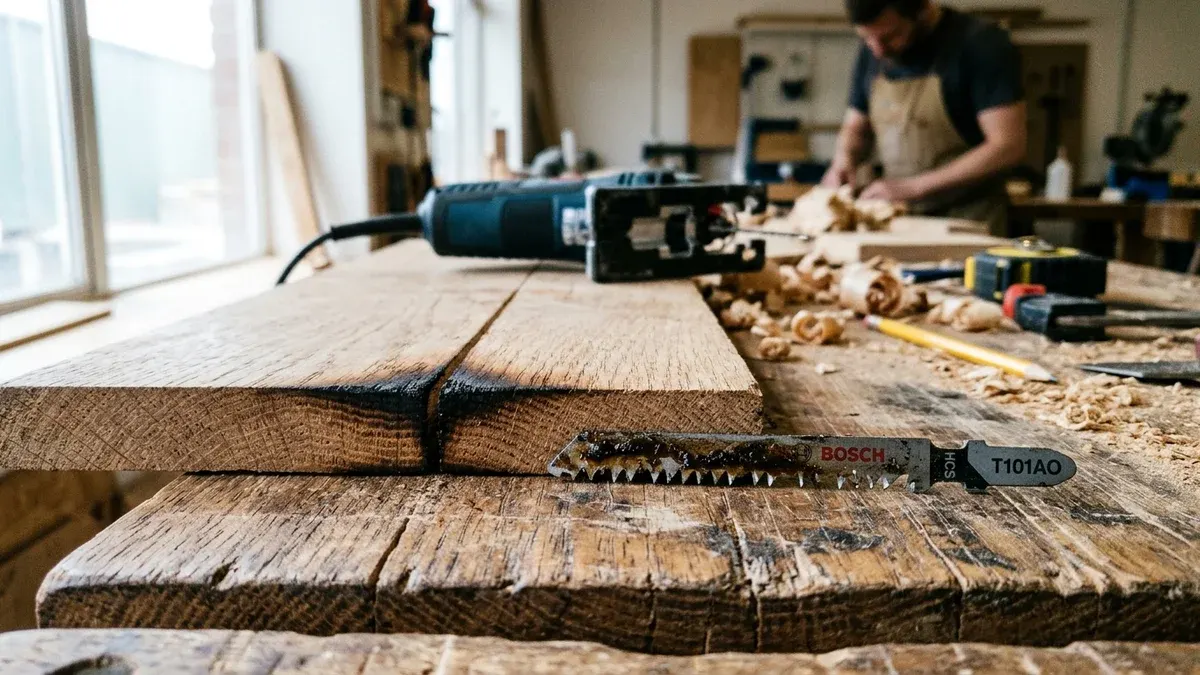
1. Dull or Gummed-Up Blade Teeth
When blade teeth lose their razor edge, they no longer shave wood fibers. Instead, they pound against the grain with immense rotational and reciprocating friction. Pitch and sap from pine or resin from plywood then bake onto the steel blade body.
- The Fix: Remove the blade and clean it with citrus resin remover. If the cutting points feel rounded to your fingernail, discard the blade immediately. A fresh $3 blade saves hundreds of dollars in ruined hardwood.
2. Trapped Sawdust Inside the Kerf
When cutting through thick stock (over 1 in.), fine sawdust cannot escape the tight slit. The sawdust packs around the reciprocating blade, acting like an oven that traps heat.
- The Fix: Turn on orbital action to Setting 1 or 2. Orbital motion kicks the blade backward on the downstroke, creating a temporary air gap that allows packed sawdust to drop out of the cut.
3. Cutting Too Slowly (Excessive Dwelling)
Beginners often move the saw with extreme caution, crawling forward at an inch per minute while the motor runs at full 3,200 SPM.
- The Problem: The teeth pass over the exact same spot dozens of times without biting into fresh material, scorching the wood fibers.
- The Fix: Maintain a confident, steady forward feed rate. Listen to the tool motor: you want a smooth, productive hum, not a shrill unloaded whine.
4. Thin Blade Twisting on Tight Curves
If you attempt to force a wide, straight-cutting blade around a tight radius, the flat sides of the blade bind hard against the wooden walls of the curve.
- The Fix: Swap to an extra-narrow scroll blade (such as the Bosch T 101 AO or T 244 D). Narrow blades pivot freely without rubbing against curve walls.
Pro Checklist for Burn-Free Cuts
- Hardwoods (Oak / Maple / Cherry): Use a bi-metal blade (BIM) with ground teeth (like Bosch T 308 BF).
- Resinous Softwoods (Pine / Fir): Clean blade teeth periodically with mineral spirits to remove sticky pitch buildup.
- Feed Pressure: Push firmly enough that the saw produces distinct chips or sawdust curls rather than microscopic scorching powder.
Browse clean-cutting blades in our T-Shank Blades Catalog or discover variable-speed saws in our US Jigsaws Review Hub.