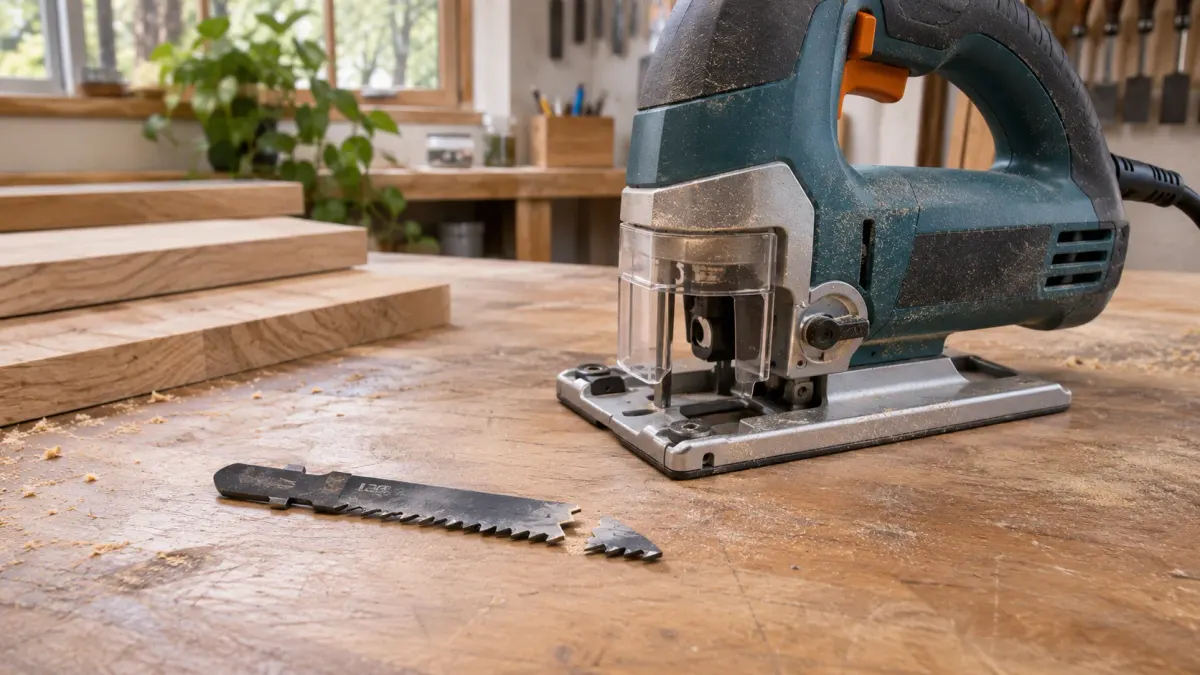
Why Jigsaw Blades Break: Common Causes and Prevention
Tired of snapping jigsaw blades? Learn the 4 primary mechanical causes of blade fracture and how to prevent them.
Published by: Sierras de CalarLast reviewed on ◷ 1 min estimated read
A snapped jigsaw blade brings your project to a dead halt and poses a serious safety hazard. Understanding why blades break will save money and keep your job running smoothly.
Every jigsaw has a vertical stroke length (typically 1 inch on pro saws). When the blade reaches the top of its stroke, the tip must still protrude at least 1/4 to 1/2 inch beneath the bottom of your workpiece.
If the blade is too short, the tip retreats inside the wood and slams directly into the solid workpiece on the way down, shattering instantly.
2. Forcing Curves with Wide-Body Blades
Trying to turn a tight radius with a standard wide-body blade subjects the thin steel spine to massive lateral torsion. Always switch to a slender scroll blade (like the Bosch T 119 BO) for tight turns.
3. Forcing Forward Feed
Leaning heavily into the saw bends the blade backward against the guide roller. Over repeated cycles, metal fatigue sets in, snapping the blade right at the shank shoulder.
4. High Carbon Steel (HCS) in Tough Metals
Using budget HCS wood blades in nails or steel plate causes immediate tooth strip and catastrophic fracture. Always use Bi-Metal (BIM) or carbide-tipped blades for metals and abrasive composites.
Why did my blade snap the instant it touched the timber?
You likely started the cut with the blade already resting against the wood. Always start the motor at full speed before gently bringing the blade into contact.
What does 'bottoming out' mean on a jigsaw?
If your blade is too short for the workpiece thickness and stroke length, the tip of the blade retreats entirely inside the cut kerf at top-dead-center, then slams into the top of the board on the downstroke, instantly snapping in half.