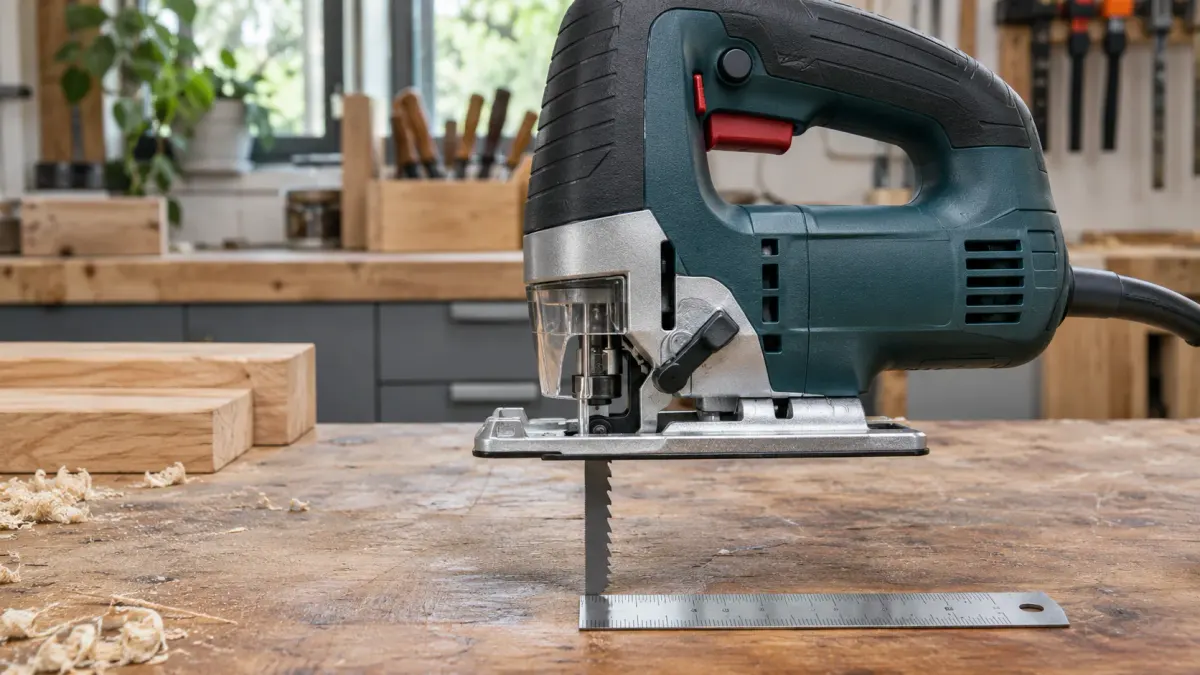
Jigsaw Stroke Length Explained: Why It Dictates Cutting Speed
Understand why a 1-inch stroke length outperforms a 3/4-inch stroke in heavy framing lumber and production speed.
Published by: Sierras de CalarLast reviewed on ◷ 1 min estimated read
Stroke length is one of the most overlooked technical specifications when buying a jigsaw, yet it directly governs how fast your saw clears sawdust and dimensions lumber.
Stroke length is the vertical distance the blade travels from its lowest position (bottom-dead-center) to its highest peak (top-dead-center) during a single reciprocation cycle.
Why a 1-Inch Stroke Outperforms a 3/4-Inch Stroke
Engages More Teeth Per Cycle: On a 1-inch (26 mm) stroke saw like the DEWALT DCS334B or Bosch JS470E, more teeth slice through the workpiece on every stroke compared to a 3/4-inch (18 mm) saw.
Superior Sawdust Evacuation: At top-dead-center, teeth loaded with sawdust emerge completely out of the kerf, allowing centrifugal force to eject chips freely. On a short-stroke saw cutting thick 2x4 lumber, teeth never emerge from the cut, trapping hot dust in the kerf and causing friction burn.
Faster Feed Rates: In side-by-side benchmark testing in 2x6 framing lumber, a 1-inch stroke saw cuts up to 35% faster than an identical SPM saw with a 3/4-inch stroke.
What is the standard stroke length on professional jigsaws?
Professional contractor-grade jigsaws feature a 1-inch (26 mm) stroke length. Compact 12V saws or entry-level DIY tools typically have a 3/4-inch (18–20 mm) stroke.
Does stroke length affect blade lifespan?
Yes. A longer stroke length distributes cutting wear across more individual teeth on the blade, prolonging blade sharpness and preventing concentrated heat build-up.