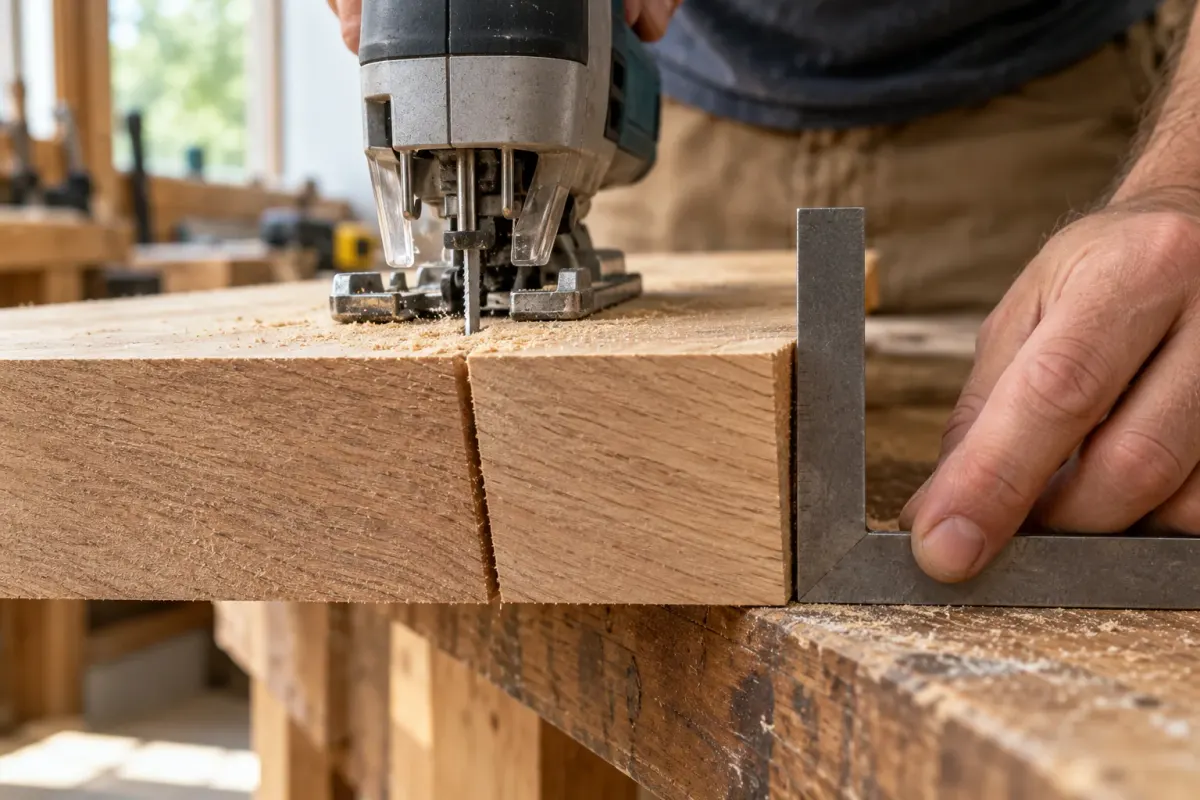
The Two Distinct Types of “Crooked” Cuts
To solve the problem, first diagnose which type of deviation you are experiencing:
- Path Drift (Surface Wandering): The tool drifts left or right away from your drawn pencil mark on the top face of the board.
- Bevel Deviation (Blade Deflection): The line on top is dead straight, but the cut edge underneath is tilted at an unwanted angle instead of a crisp 90° right angle.
4 Common Culprits & Proven Workshop Fixes
1. Excessive Forward Push (Feed Pressure)
The most common mistake woodworkers make is physically forcing the jigsaw forward. Unlike a circular saw with a rigid 7-1/4 in. steel disc, a jigsaw blade is a slender cantilevered strip of steel.
- The Fix: Let the teeth do the cutting. Apply light, steady forward guidance and let the motor maintain high RPMs. If the motor bogs down or slows, you are pushing too aggressively.
2. Thin, Worn, or Inappropriate Blades
Dull teeth on one side of a blade cause it to cut faster on the sharp side, automatically steering the blade into a gentle curve. Furthermore, using a standard ultra-narrow scroll blade on a 2x4 framing stud will cause severe flexing.
- The Fix: Inspect the blade for blue heat discoloration or dull teeth. For straight 90° cuts in stock over 3/4-in. thick, switch to a precision heavy-stock blade such as the Bosch T 144 DP or DEWALT DT2074, which feature reinforced back spines.
3. Misaligned Guide Roller
All modern jigsaws use a grooved needle-bearing roller behind the blade to stabilize lateral thrust. If the blade slips out of the groove, or if the roller bracket is bent, the blade will immediately veer sideways.
- The Fix: With the tool unplugged (or battery removed), ensure the spine of the T-shank blade rests squarely in the center of the guide roller groove at the bottom of its stroke.
4. Uncalibrated Bevel Shoe Detents
Factory stamped bevel detents at 0° are often slightly off-angle out of the box.
- The Fix: Loosen the shoe bevel clamp. Place an accurate machinist’s square between the bottom of the cast aluminum shoe and the flat face of the blade (not against the teeth). Tighten the lock lever firmly once you confirm a dead-true 90.0° angle.
Pro Cutting Technique for Laser-Straight Edges
- Score the Line: Scribe your layout mark with a utility knife to sever the top wood grain fibers.
- Use Orbital Action Carefully: Keep pendulum orbital action at Setting 0 or 1 for dense hardwoods or framing lumber when straightness takes priority over cutting speed.
- Clamp a Straight-Edge Guide: Clamp a rigid aluminum level to your workpiece, calculating the exact offset distance from the blade to the edge of your jigsaw shoe.
Explore recommended blades in our T-Shank Blades Catalog or discover high-precision saws in our Top US Jigsaws Guide.