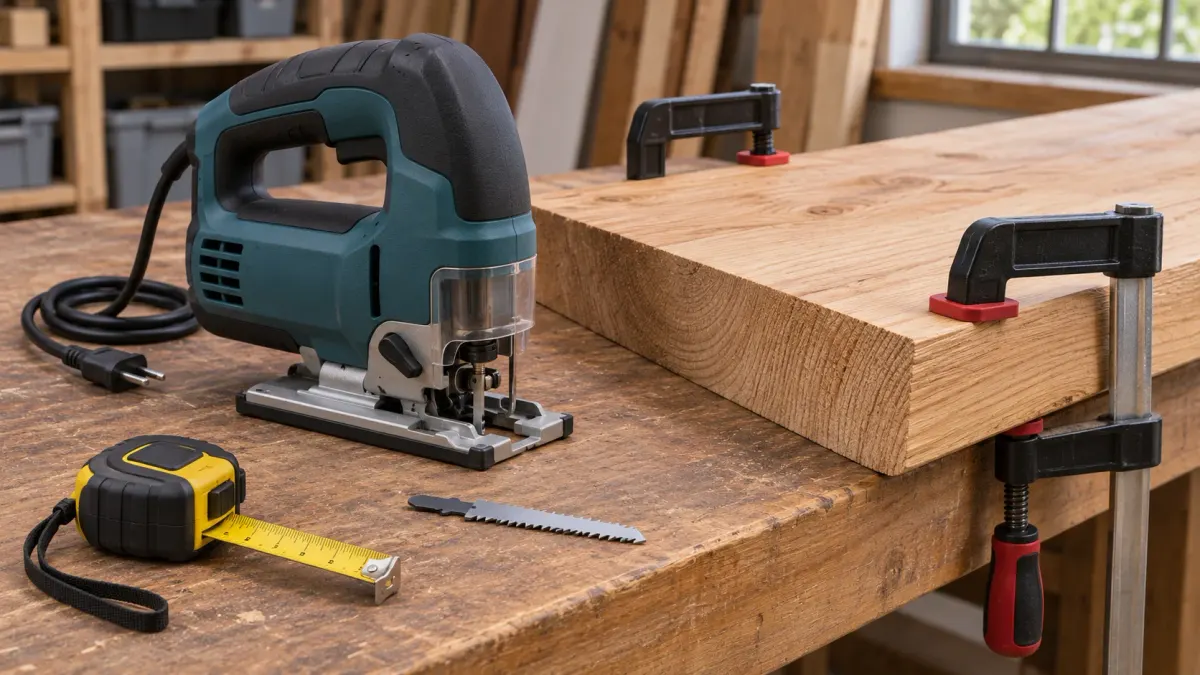
Calculating Minimum Blade Length
If your blade is too short, the tip will retract inside the bottom face of the wood at the top of its stroke. When it plunges back down, the tip will smash into the workpiece, violently bending the blade and possibly stripping the tool’s drive gears.
$$\text{Minimum Blade Length} = \text{Board Thickness} + \text{Tool Stroke Length} + 0.5\text{ in. Margin}$$
For example, on a tool with a 1-in. stroke cutting a 1-1/2-in. thick butcher block: $$1.5\text{ in.} + 1.0\text{ in.} + 0.5\text{ in.} = 3.0\text{ in. minimum blade length}$$
3 Essential Settings for Thick Stock
1. Match Blade Pitch (TPI) to Depth
Fine 12-TPI blades pack full of sawdust immediately when cutting through 2 inches of timber.
- Framing Lumber (2x4 / 2x6 Pine): Use an aggressive 6 TPI to 8 TPI blade like the Bosch T 144 D or DEWALT DT2165. Large tooth gullets pull sawdust down and out of the kerf.
- Hardwood Butcher Block (Oak / Maple / Walnut): Use a bi-metal 8 TPI to 10 TPI precision ground blade like the Bosch EXPERT T 308 BF.
2. Leverage Orbital Action
Orbital motion swings the blade forward on the upstroke (cutting phase) and pulls it back away from the wood on the downstroke:
- This backward movement allows sawdust to dump freely out of the kerf, preventing binding and motor overheating.
- Set orbital selector to Position 2 or 3 for speed, or Position 1 if squareness is your primary concern.
3. Maintain High SPM with Gentle Feed
Do not drop motor speed when cutting thick lumber. Keep your variable speed dial on Max (Setting 5 or 6) to maintain motor cooling airflow. Guide the saw with light hand pressure, letting the blade clear its own path.
Step-by-Step Workshop Workflow
- Secure the Workpiece: Double-clamp your board to sturdy sawhorses or a workbench. Thick wood induces high vibration; loose boards rattle and destroy blade teeth.
- Support the Cut-off Piece: Never let the falling cut-off piece snap before the cut finishes, as the falling weight will bind and warp the blade tip.
- Inspect the Roller Guide: Verify that the blade spine stays seated inside the roller wheel to prevent lateral wander.
Compare high-torque professional models in our Complete US Jigsaws Catalog and browse long T-shank options in our Jigsaw Blades Catalog.