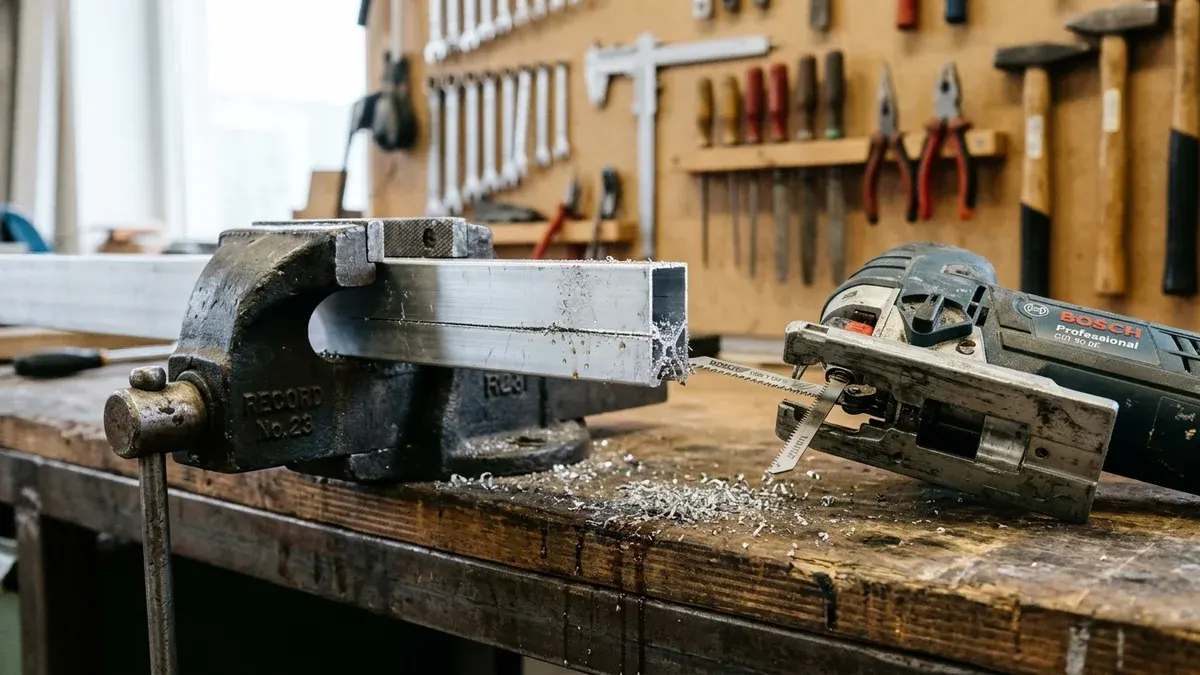
The most common mistake when cutting metal or aluminum with a jigsaw is pinning the trigger at full speed and forcing the tool forward. The result is always immediate: screeching chatter, a plume of acrid smoke, and a stripped blade with bald teeth in under ten seconds.
Cutting metal with a jigsaw is straightforward once you flip the script compared to woodworking. While wood rewards aggressive orbital action and high reciprocating speeds, metal demands deliberate patience, dialed-back stroke rates, and continuous cutting lubrication.
The Physics of Metal Cutting: Heat Is Your Enemy
High-Speed Steel (HSS) and Bi-Metal (BIM) blades are engineered for exceptional hardness, but their cutting edge loses its hardness temper if tooth tips exceed 900°F (500°C).
When running at top speed against ferrous steel or extruded aluminum, friction heat builds faster than it can dissipate. The cutting edges soften in fractions of a second, the teeth fold backward, and the blade transitions from shearing chips to friction-rubbing. Once rubbing begins, thermal runaway destroys the blade permanently.
3 Essential Jigsaw Settings for Metal
Before touching the blade to your workpiece, verify these three tool settings:
- Orbital pendulum action set strictly to 0: Orbital action kicks the blade aggressively forward on each upstroke. In lumber, this clears massive sawdust chips; in metal, it slams tooth tips straight into the unyielding edge of the kerf, fracturing carbide or HSS points. Keep orbital mode completely off.
- Stroke speed dialed down (Settings 1 to 3): Set your variable speed dial between 1 and 3 (roughly 1,000–1,500 SPM). The motor should run relaxed, and the stroke cycle should be slow and controlled.
- Gentle, continuous feed pressure: Do not lean your body weight into the saw. Press the baseplate firmly flat against the workpiece to suppress chatter and let the teeth cut at their natural rate.
Cutting Lubrication: 1 Blade vs. 10 Blades
Dry metal cutting burns up blades in minutes. Adding lubricant along the cutline multiplies blade longevity tenfold:
- For mild steel and sheet metal: Lay a bead of cutting oil, tapping fluid, or 3-in-One oil directly along your scribed line. The fluid cools the cut zone and suspends fine swarf.
- For aluminum and non-ferrous alloys: Aluminum does not wear down teeth—it melts, gums up, and friction-welds into the gullets between teeth (galling). Rub beeswax, candle wax, or spray WD-40 / denatured alcohol along the cut line to ensure chip ejection.
Choosing the Right Jigsaw Blade by Metal & Thickness
Look for Bi-Metal or HSS blades with fine tooth pitches:
1. For Thin Sheet Steel (1/16” to 1/8”): Bosch T118A
The industry standard. Features a very fine 21–24 TPI wavy-set tooth geometry. This ensures at least 3 teeth engage the sheet thickness simultaneously, eliminating tooth snagging and metal tearing.
2. For Aluminum Profiles & Pipes: Bosch T127D
Designed specifically for non-ferrous metals up to 1/4” thick. Features deep, milled side-set gullets (8 TPI) that quickly discharge soft aluminum chips without clogging.
3. For Heavy Gauge Steel & Conduit: Bosch T118G or T123X
Bi-metal construction featuring progressive tooth spacing designed to cut thicker structural pipe, unistrut, and angle iron cleanly without tooth stripping.