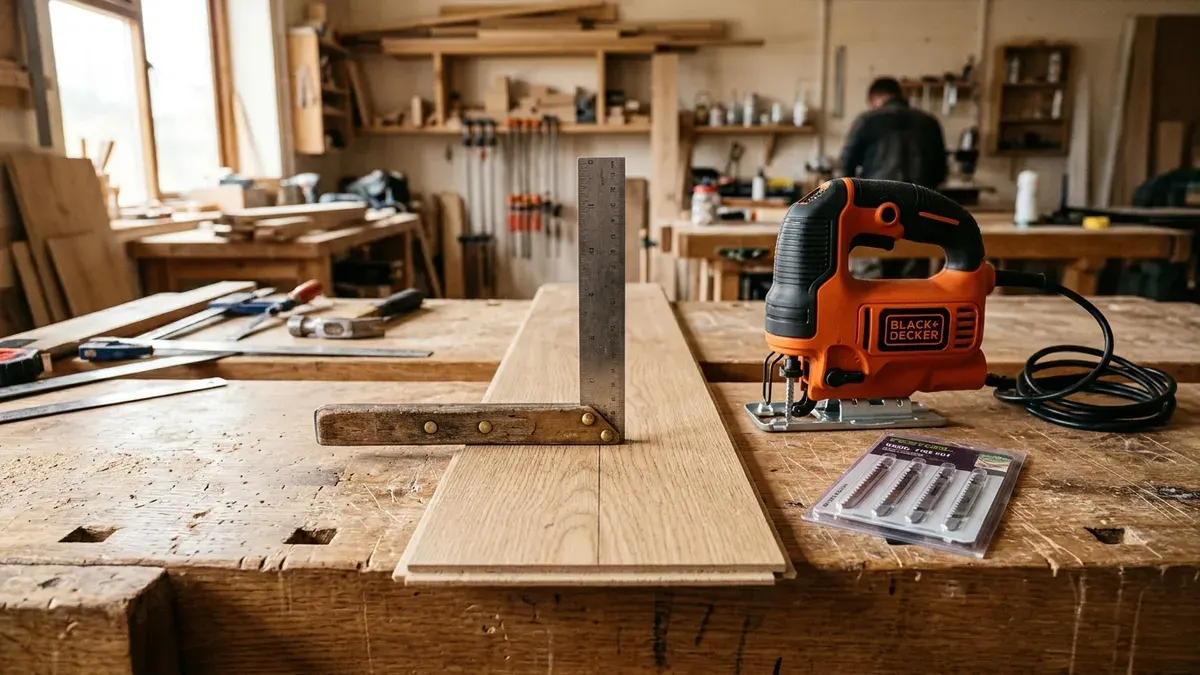
Laminate flooring planks look stunning once installed, but cutting them can be frustrating. The ultra-durable top wear layer contains microscopic aluminum oxide (corundum) particles that dull standard carbon steel blades in three cuts, sending splintered white chips across your finished bevel.
Getting laser-clean, splinter-free cuts on laminate planks requires understanding how the blade teeth interact with the plank’s layered structure. With the right blade geometry and two foundational adjustments, your cross-cuts, rip-cuts, and door jamb notches will come out crisp on the first attempt.
Why Laminate Planks Destroy Standard Blades
A laminate plank is not solid lumber; it is a high-tech composite sandwich made of three distinct layers:
- High-Density Fiberboard (HDF) Core: Extremely dense wood fibers compacted under immense hydraulic pressure with thermosetting resins.
- Decorative Photographic Layer: The printed pattern replicating natural oak, walnut, or pine grain.
- Transparent Corundum Overlay: The top melamine wear shield saturated with aluminum oxide crystals.
When a standard woodworking blade strikes this aluminum oxide layer at 3,000 strokes per minute, the tooth tip acts as if it is hitting fine grinding wheel grit. Without Bi-Metal or Tungsten Carbide tips, the tooth’s cutting edge is polished blunt almost immediately.
Up-Cut vs. Down-Cut Blades: Getting the Face Orientation Right
Standard jigsaw blades cut on the upstroke (pulling upward toward the tool’s baseplate). When teeth exit the top of the board, they lift and rupture the decorative film, producing visible tear-out.
You have two solutions:
Solution A: Cut Face Down with Standard Up-Cut Blades (e.g., Bosch T101B)
Flip the laminate plank over so the decorative side faces the workbench. Draw your cut line on the rough backing paper. As the teeth pull upward, they enter through the decorative face and exit through the underside, leaving the top edge pristine.
Solution B: Cut Face Up with Reverse-Tooth Blades (Bosch T101BR)
Reverse-tooth (down-cut) blades feature downward-pointing teeth. They cut on the push stroke, driving wood fibers down into the core. This allows you to cut with the decorative wood grain facing straight up, making pencil marks and alignment lines easy to follow.
Machine Settings for Clean Flooring Cuts
- Orbital pendulum set to 0: Never engage orbital action on laminate or engineered parquet.
- Full stroke speed (Settings 5 to 6): Run the motor at full RPM so the fine teeth slice cleanly through dense HDF without bogging down.
- Firm downforce: When using reverse-tooth blades, the saw will naturally try to kick upward off the board. Press down firmly on the top handle or barrel grip throughout the cut.