1. Choose the Right Scroll Blade
Standard wood blades measure roughly 5/16 in. (8 mm) wide from tooth tip to spine. While great for straight lines, this wide body prevents the tool from turning tightly.
- For Clean Furniture Curves (Plywood / Hardwood): Use the Bosch T 101 AO (Clean for Wood). It features a tiny 3/16-in. (4 mm) body and pointed teeth designed for splinter-free curved cuts down to a 5/8-in. radius.
- For Fast Rough Curves in Framing Lumber: Use the Bosch T 244 D (Speed for Wood Curvo), which combines a narrow spine with aggressive 6-TPI raker teeth.
2. Drilling Clean Starter Holes (Interior Circles)
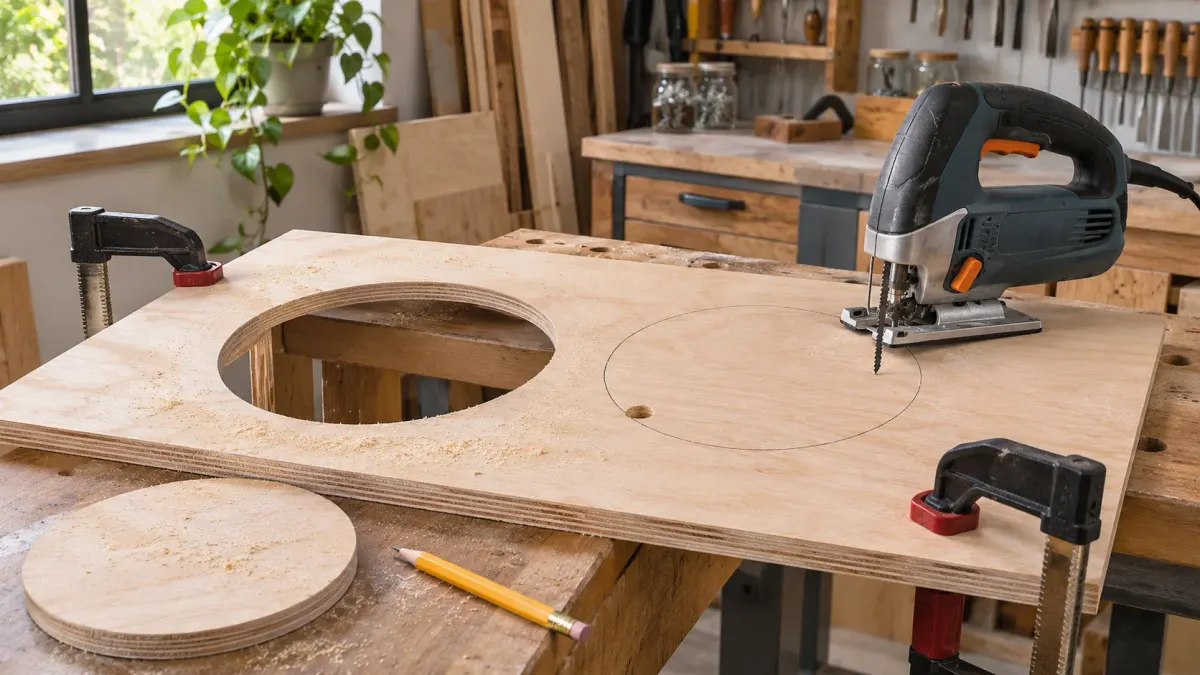
When cutting an interior sink cutout or round speaker hole:
- Mark your circular circumference with a compass or template.
- Select a spade bit or Forstner bit measuring 3/8 in. or 1/2 in.
- Drill your pilot hole in the waste material immediately adjacent to your pencil layout line.
- Tangent your cut smoothly into the drawn line so the blade eases into the radius without a sharp notch.
3. Cutting Relief Cuts on Tight Outside Radii
When cutting tight exterior shapes (like decorative corbels or bracket curves), the waste piece can pinch and bind the back of the blade.
- Pro Technique: Make several straight “relief cuts” from the outer waste edge into your line before starting your curve.
- As your blade navigates the circle, waste blocks drop away harmlessly, instantly relieving kerf friction.
4. Building a Simple DIY Trammel Circle Jig
To cut a true geometric circle (like a round tabletop) without wandering:
- Fasten a scrap piece of 1/4-in. hardboard or plywood beneath the base of your jigsaw shoe.
- Extend a strip of hardboard out to the desired circle radius.
- Drill a small pivot hole through the strip at your exact radius point.
- Drive a nail or screw through the pivot hole into the center point of your workpiece.
- Power up the tool and swing the saw in a smooth, continuous 360° circle. The fixed pivot prevents any inward or outward drift.
Explore precision barrel-grip jigsaws favored for scrollwork in our US Jigsaws Review Hub and browse scroll blades in our Jigsaw Blades Catalog.