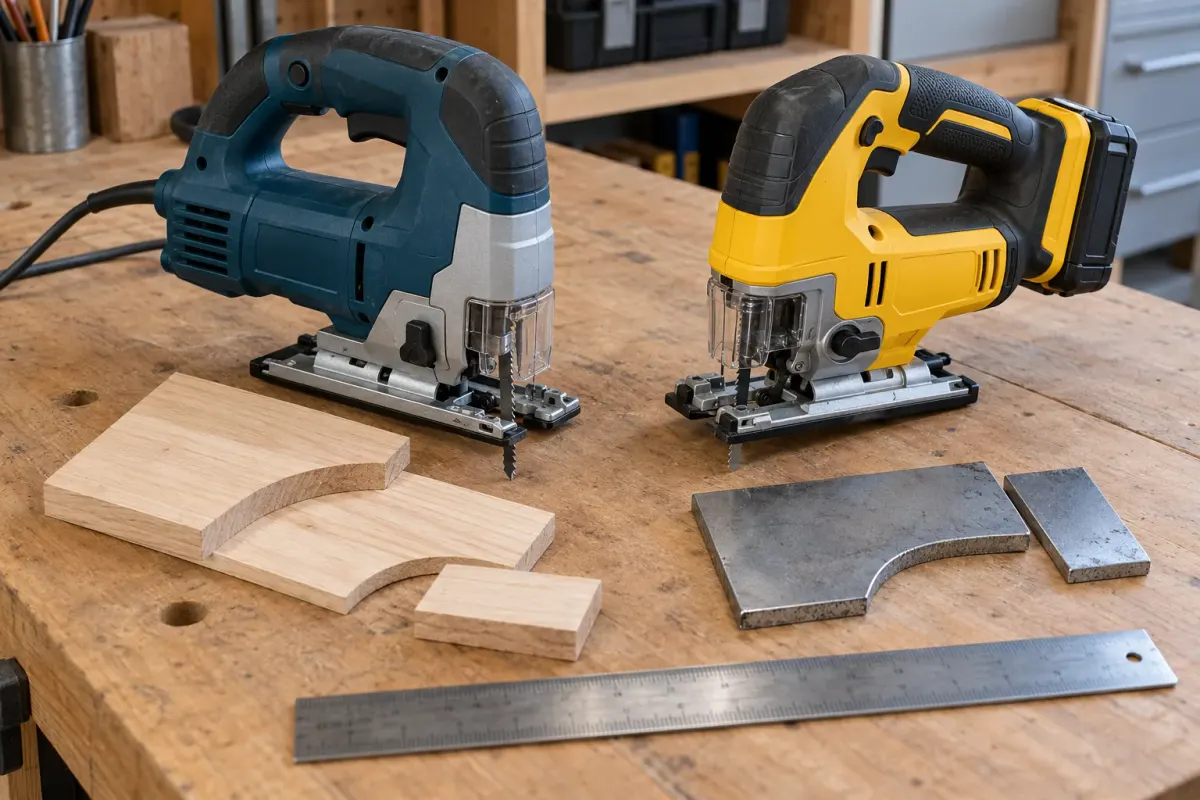
How to Compare Jigsaws: Decoding Technical Spec Sheets
Cut through marketing fluff. Learn which numbers on a tool box dictate real cutting speed, accuracy, and endurance.
Published by: Sierras de CalarLast reviewed on ◷ 1 min estimated read
Tool manufacturers advertise dozens of numbers on their boxes. Knowing which specifications represent real-world performance will prevent costly buyer remorse.
The speed and aggressiveness of a jigsaw depend on the combination of two critical metrics:
No-Load Stroke Rate (SPM): Ranges from 0 to 3,200 or 3,500 strokes per minute. Variable-speed dials allow slowing down for steel and acrylic.
Stroke Length: The vertical distance the blade travels. Pro saws feature a 1 in. (26 mm) stroke length, while compact or budget saws feature 3/4 in. (18 mm). A longer stroke length engages more teeth per stroke and evacuates sawdust much faster.
2. Power Output: Amps vs. Voltage
Corded Amperage: Professional 120V saws rate between 6.5 Amps and 7.2 Amps (e.g., Bosch JS470E at 7.0A). Anything below 5.0 Amps is strictly for light DIY craft hobbyists.
Cordless Voltage: 18V and 20V MAX systems deliver ample torque for all workshop tasks when paired with high-output 4.0 Ah or 5.0 Ah battery packs.
3. Cutting Capacities Across Materials
Check the manufacturer’s declared limits:
Wood: 5-5/16 in. (135 mm) is the professional benchmark.
Mild Steel: 3/8 in. (10 mm) indicates heavy-duty gearing.
Not necessarily. SPM (strokes per minute) must be paired with stroke length. A saw with 3,000 SPM and a 1-inch stroke clears substantially more material than one with 3,000 SPM and a 3/4-inch stroke.
What cutting depth capacity should I expect for wood?
Professional jigsaws declare between 5-5/16 in. (135 mm) and 5-7/8 in. (150 mm) in softwood. Budget DIY models typically max out around 2-1/2 in. to 3-1/2 in.