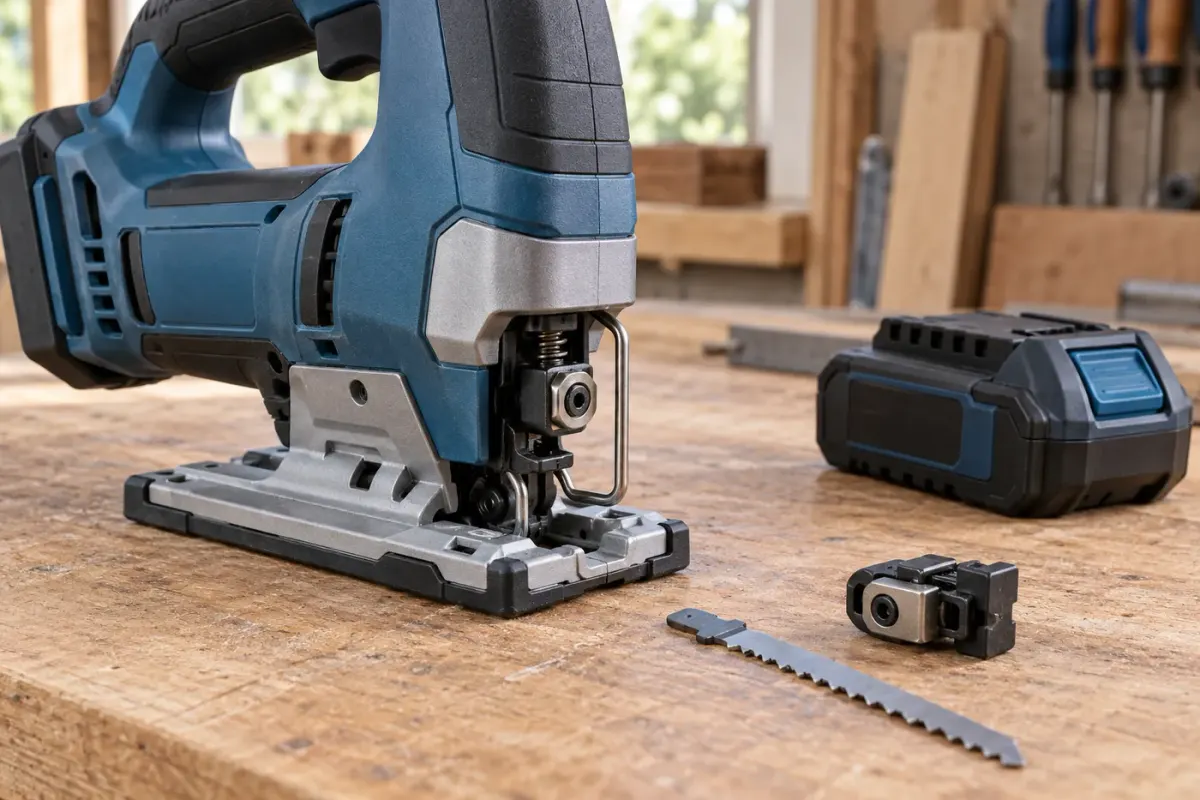
Always Disconnect Power and Allow the Blade to Cool
Before bringing your hands near the blade clamp, unplug the 120V power cord or detach the battery pack (such as a DEWALT 20V MAX or Milwaukee M18 pack).
If you just completed a heavy cut in oak or steel, the blade will be scalding hot. Use leather work gloves or a rag to avoid finger burns. Set the jigsaw on a clean, stable workbench with the shoe facing upward.
Opening Modern Tool-Free T-Shank Clamps
The vast majority of modern American jigsaws (including the DEWALT DCS334B, Bosch JS470E, and Milwaukee 2737-20) feature keyless quick-release blade chucks:
- Pull or Twist the Release Lever: Pull the front-mounted lever outward or rotate the spring-loaded locking collar on the reciprocating shaft.
- Eject the Worn Blade: Most pro-grade saws feature automatic spring ejection, dropping the blade straight out without requiring you to pull it manually.
- Older Saws with Hex Screws: If your tool uses an older mechanical clamp (like some vintage Porter-Cable or Black+Decker models), loosen the set screw using the onboard hex key.
Seating the New Blade Correctly
Select the appropriate blade for your material:
- Use universal T-shank blades; older U-shanks do not lock securely into modern automatic chucks.
- Orient the blade with the teeth facing forward.
- Insert the blade shank straight into the chuck until you hear or feel a firm mechanical click.
- Crucial Check: Ensure the smooth back spine of the blade sits squarely inside the grooved channel of the lower blade guide roller. If the blade sits to the side of the roller, it will immediately deflect and cut crooked.
Testing Blade Retention Before Powering Up
Always pull firmly downward on the blade with a gloved hand to verify that the locking tangs have engaged.
Once secured, reattach the battery, set the jigsaw shoe flat on a piece of scrap 2x4 lumber, and perform a short 2-inch test pass. If you detect excessive vibration or chattering, shut off the tool immediately and reseat the blade.
Browse our Top US Jigsaw Blades Catalog to explore precision T-shank options for dimensional lumber, sheet metal, and countertops.