The Advantages of a Stationary Jigsaw Setup
When scroll-cutting wooden models, puzzle pieces, or intricate internal curves in 1/8” to 3/8” (3-10 mm) plywood, operating a handheld jigsaw is cumbersome: the wide metal base obscures delicate pencil marks, and small workpieces vibrate aggressively unless clamped down with multiple vices.
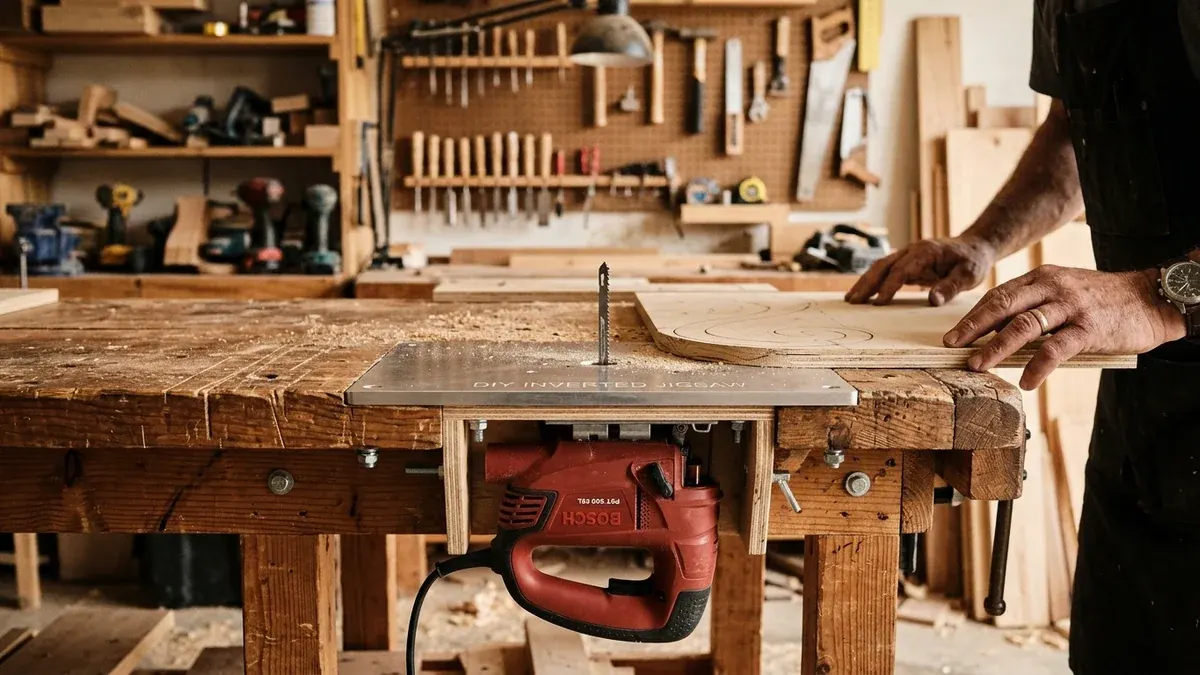
By suspending the machine securely upside down beneath a flat table surface:
- Both hands remain entirely free to maneuver the workpiece smoothly across the tabletop.
- The cutting line stays unobstructed directly beneath good overhead workshop lighting.
- Miter gauges and rip fences can be fitted to perform repeatable straight and beveled cuts accurately.
The Three Technical Pillars of a Safe Inverted Installation
- Rigid, Flat Mounting Sub-Plate: Never screw your jigsaw directly into soft MDF or chipboard; reciprocating vibrations will quickly strip threads. Install a machined 1/4” (6 mm) aluminum router/jigsaw plate or use an engineered modular workstation like the Wolfcraft Master Cut 2600.
- Overhead Blade Support Guide with Bearings: In an inverted setup, the blade tip is completely unsupported. Pushing timber through curves exerts sideways forces that twist the blade out of vertical alignment. An overhead support arm equipped with dual miniature ball bearings holds the blade spine perfectly vertical for clean 90-degree edges.
- External NVR (No-Volt Release) Safety Switch: Never use a zip-tie or tape to clamp down your tool trigger plugged directly into a wall outlet. An NVR magnetic switch drops out when power is interrupted, and features an oversized slap paddle you can hit instantly with your hand or knee.
Comparison of Inverted Jigsaw Mounting Options
| Mounting Setup | Structural Rigidity | Overhead Guide Support | Electrical Safety | Assembly Complexity |
|---|---|---|---|---|
| Wolfcraft Master Cut 2600 | High (Steel chassis) | Optional accessory | Factory NVR switch included | Pre-engineered quick setup |
| Neutechnik Jigsaw Guide Arm | High (Roller bearings) | Yes (Dual ball bearings) | Requires external NVR box | Universal clamp-on mounting |
| DIY Aluminum Plate Benchtop | Medium to High | Custom-fabricated | Must wire external safety switch | Demands careful milling & calibration |
View Jigsaw Tables and Mounting Plates on Amazon →
Workshop Best Practices and Hazard Prevention
- Always Utilize a Push Stick: Never feed workpieces with your fingers closer than 3 inches (8 cm) to the reciprocating blade. Keep wooden push blocks and sacrificial notched sticks within arm’s reach.
- Active Underside Dust Extraction: Connect a shop vac directly to the enclosed housing beneath the table. Inverted reciprocating saws throw high volumes of sawdust straight into the tool motor vents, causing rapid overheating and premature armature burnout without active vacuum suction.